Zero crossing edge detection
Edge detection can also be done by detecting the zero crossing point of the second derivative
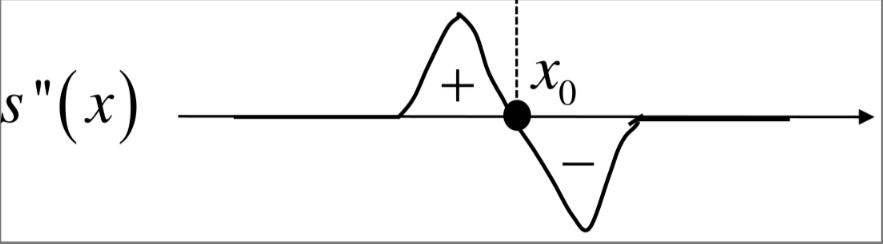
The second derivative can be computed by the Hessian matrix as $n^THm$ with
$$ n = \frac{\nabla I(x,y)}{\Vert \nabla I(x,y) \Vert}, \space \space and \space \space H = \begin{bmatrix} \frac{\delta^2 I(x,y)}{\delta x^2} & \frac{\delta^2 I(x,y)}{\delta x \delta y} \ \frac{\delta^2 I(x,y)}{\delta y \delta x} & \frac{\delta^2 I(x,y)}{\delta y^2 } \ \end{bmatrix} $$ This implementation is too computational expensive so another solution is to use the Laplacian
$$ \nabla^2I(x,y) = \frac{\delta^2 I(x,y)}{\delta x^2} + \frac{\delta^2 I(x,y)}{\delta y^2} = I_{xx} + I_{yy} $$
This solution needs to filter out the noise, this is done through convolution with Gaussian function
$$\overset{\sim}I(x,y) = I(x,y)\ast G(x,y)$$