Homography
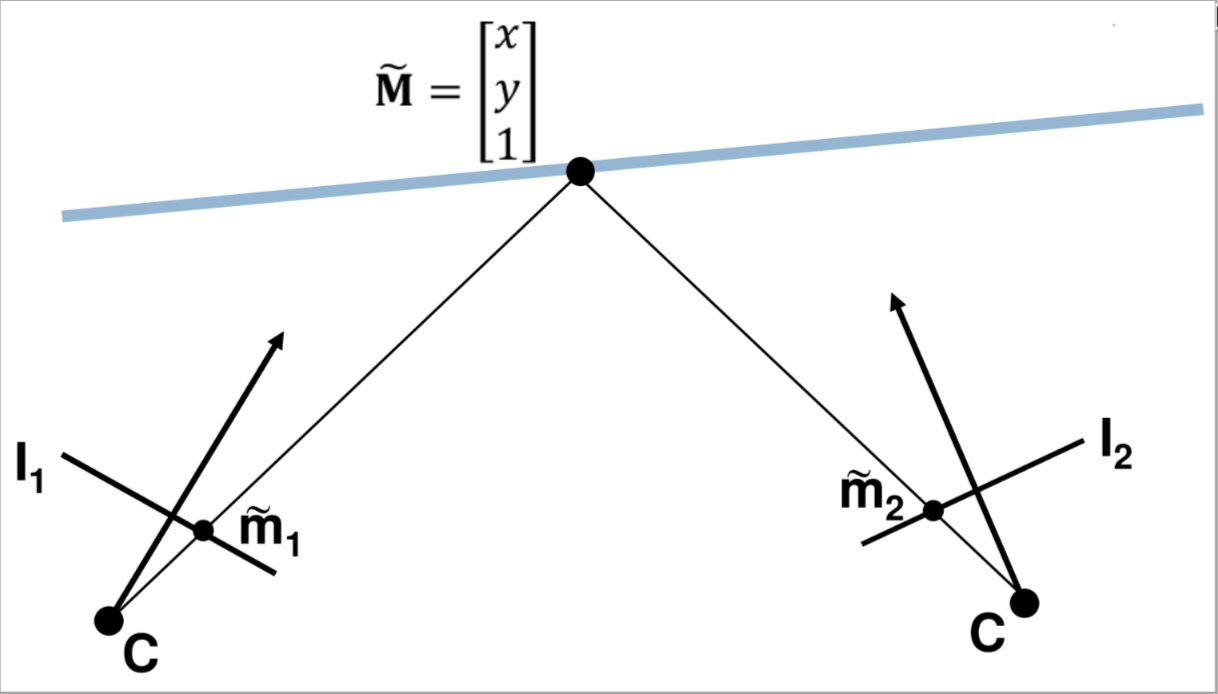
Let’s take the case where the camera is imaging a planar scene, in this case it can be said that the $z = 0 \space \forall \space \overset{\sim}w$, in this scenario the $PPM$ becomes
$$ k\overset{\sim}m= \overset{\sim}P \overset{\sim}w = \begin{bmatrix} p_{1,1} &p_{1,2} &p_{1,3} &p_{1,4} \ p_{2,1} &p_{2,2} &p_{2,3} &p_{2,4} \ p_{3,1} &p_{3,2} &p_{3,3} &p_{3,4} \ \end{bmatrix} \times \begin{bmatrix} x\ y\ 0\ 1\ \end{bmatrix}= \begin{bmatrix} p_{1,1} &p_{1,2} &p_{1,4} \ p_{2,1} &p_{2,2} &p_{2,4} \ p_{3,1} &p_{3,2} &p_{3,4} \ \end{bmatrix} \times \begin{bmatrix} x\ y\ 1\ \end{bmatrix}= H\overset{\sim}M $$
this is exploited in camera callibration with the zhang’s method.
Properties
cause $\det{H} \neq 0$ two distinct images of a planar scene are related by homography
$$ \overset{\sim}m_{1} =H_{1}\overset{\sim}M \Rightarrow \overset{\sim}m_{1} =H_{1}H_{2}^{-1}\overset{\sim}m_{2} $$ $$ \overset{\sim}m_{2} =H_{2}\overset{\sim}M \Rightarrow \overset{\sim}m_{2} =H_{2}H_{1}^{-1}\overset{\sim}m_{1} $$
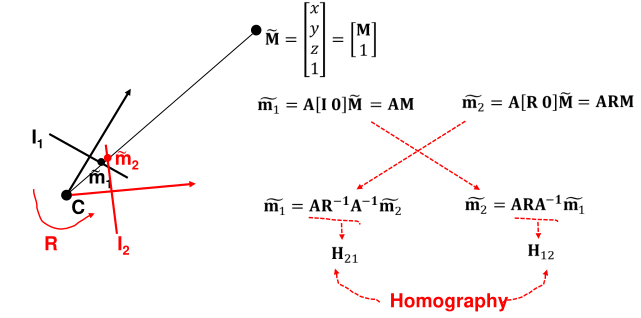
Rotation relation
Any two images taken by a camera rotating about the optical center are related by homography
Intrinsic parameter relation
any two images taken by two different cameras (different $A$ matrix so different intrinsic parameters) in a fixed pose are related by homography
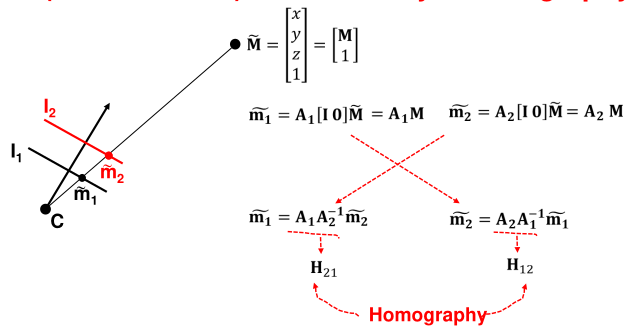
In conclusion we can say that if the camera is imaging a planar scene we can find relations between images that are taken from different angles or with different camera sensors