Gaussian filter
Gaussian filter is an LTE operator with a 2D Gaussian function as a impulse response (with $\mu = 0$ and a constant diagonal covariance matrix)
$$ G(x,y) = G(x)G(y) = \frac{1}{2\pi\sigma^2}e^{-\frac{x^2+y^2}{2\sigma^2}} $$
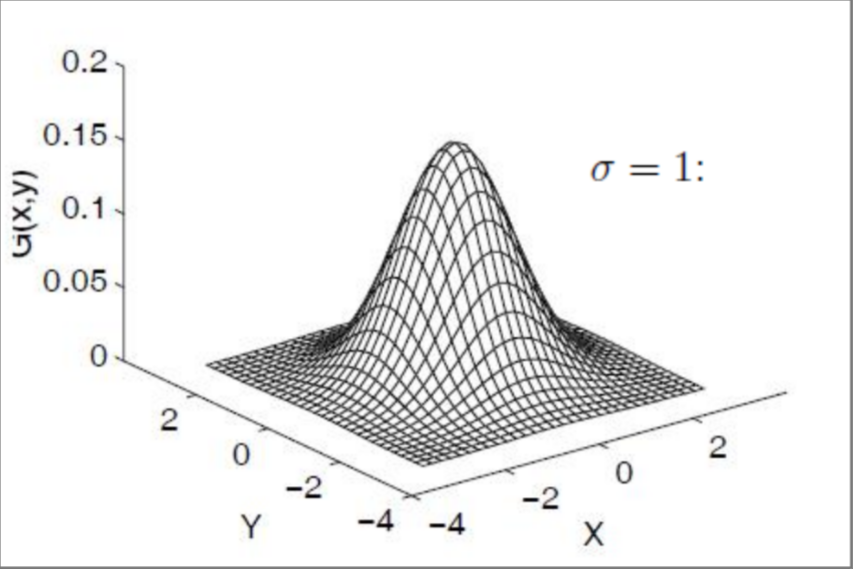
The effect of increasing $\sigma$ can be seen as reducing the importance of the closest points and increasing the importance of farther points smoothing the image
Choosing kernel size
In a real implementation the Gaussian function need to be approximated by a discrete representation by sampling the function in a kernel matrix, so the matrix size need to be set
- with higher size matrix becomes more accurate
- computational cost grows with matrix size
so a rule of thumb is to select the kernel size based on the $\sigma$ value as
$$ kernel \space size = (2k+1) \times (2k +1) \space where \space k = 3\sigma $$
as $3\sigma$ covers the 99% of the area of the function (energy)
Exploiting separability to improve performance
To improve the computational complexity, the separability of the 2D Gaussian function can be used as $G(x,y) = G(x)G(y)$
$$ I(x,y)\ast G(x,y) = I(x,y)\ast G(x)\ast G(y) =I(x,y)\ast G(y)\ast G(x) $$
The speedup improvements of this process can be expressed as
$$ S =\frac{2(2k+1)^2}{4(2k + 1)} = k +\frac{1}{2} \space with $$ $$ NOPS_{2D \space filter} =2(2k+1)^2\ $$ $$ NOPS_{1D \space filter} =4(2k+1)\ $$