Color based segmentation
Given a pixel $p$, and the color intensity is defined as $I(p) = \begin{bmatrix}I_r(p)\ I_g(p)\ I_b(p)\ \end{bmatrix}$ the segmentation can be done by calculating the distance from each color vector from a reference background color $\mu$
$$ \forall \space p \in I \begin{cases} d(I(p),\mu)\leq T \rightarrow O(p) = Background \ d(I(p),\mu)\gt T \rightarrow O(p) = Foreground\ \end{cases} \space with $$ $$ d(I(p),\mu) = \sqrt{(I_r(p)-\mu_r)^2+ (I_g(p)-\mu_g)^2 + (I_b(p)- \mu_b)^2} $$
the $\mu$ vector can be obtained by a set of training images as the mean of the samples:
$$ \mu = \begin{bmatrix}\mu_r \ \mu_g \ \mu_b\end{bmatrix} = \frac{1}{N}\sum_{k=1}^{N}I(p_k) $$
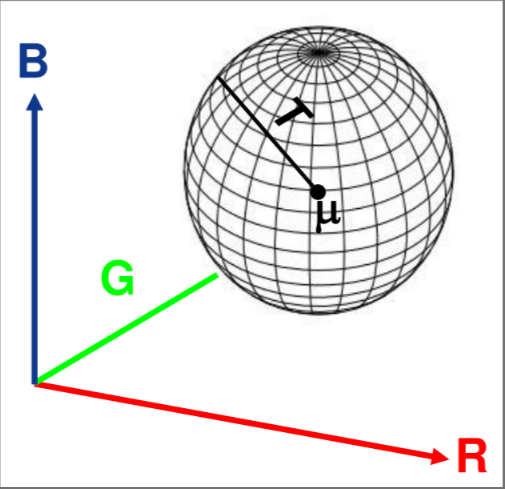
and then the segmentation become a classification task where the foreground pixels are the ones in a 3d sphere with center $\mu$
Mahalanobis distance
A more precise way of making color based segmentation is to consider the covariance also with means, the covariance matrix is obtained in the training phase as follows
$$ \Sigma = \begin{bmatrix} \sigma^2_{rr} &&\sigma^2_{rg} &&\sigma^2_{rb} \ \sigma^2_{gr} &&\sigma^2_{gg} &&\sigma^2_{gb} \ \sigma^2_{br} &&\sigma^2_{bg} &&\sigma^2_{bb} \ \end{bmatrix} \space with $$ $$ \sigma^2_{ij} = \frac{1}{N}\sum_{k=1}^{N}(I_i(p_k) - \mu_j)(I_j(p_k) - \mu_j) $$ $$ i,j \in {r,g,b} $$ The new distance measure is given by the inclusion of the covariance matrix in the euclidean distance
$$ d_M(I(p),\mu) = \sqrt{(I(p)-\mu)^T \Sigma^{-1}(I(p)-\mu)} $$
That in the case of a diagonal covariance matrix becomes
$$ d_M(I(p),\mu) = (\frac{(I_r(p) - \mu_r)^2}{\sigma^2_{rr}} + \frac{(I_g(p) - \mu_g)^2}{\sigma^2_{gg}} +\frac{(I_b(p) - \mu_b)^2}{\sigma^2_{bb}}) $$
The mahalanobis distance weights the differences between the color components unequally (inversely proportional to the learned variances ), This as the effect of lower the consideration of sparse components