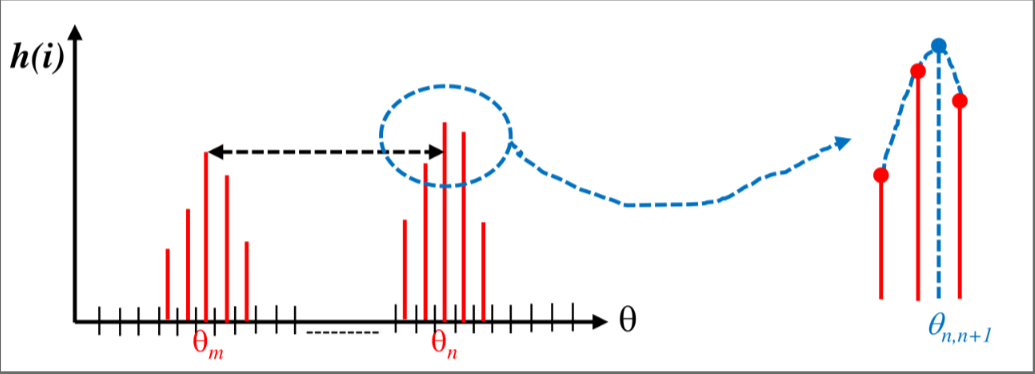
Canonical orientation
In order to obtain a reference frame for computing the descriptor of a keypoint a local reference frame is needed, one solution is to chose the direction in which most of the gradient is found
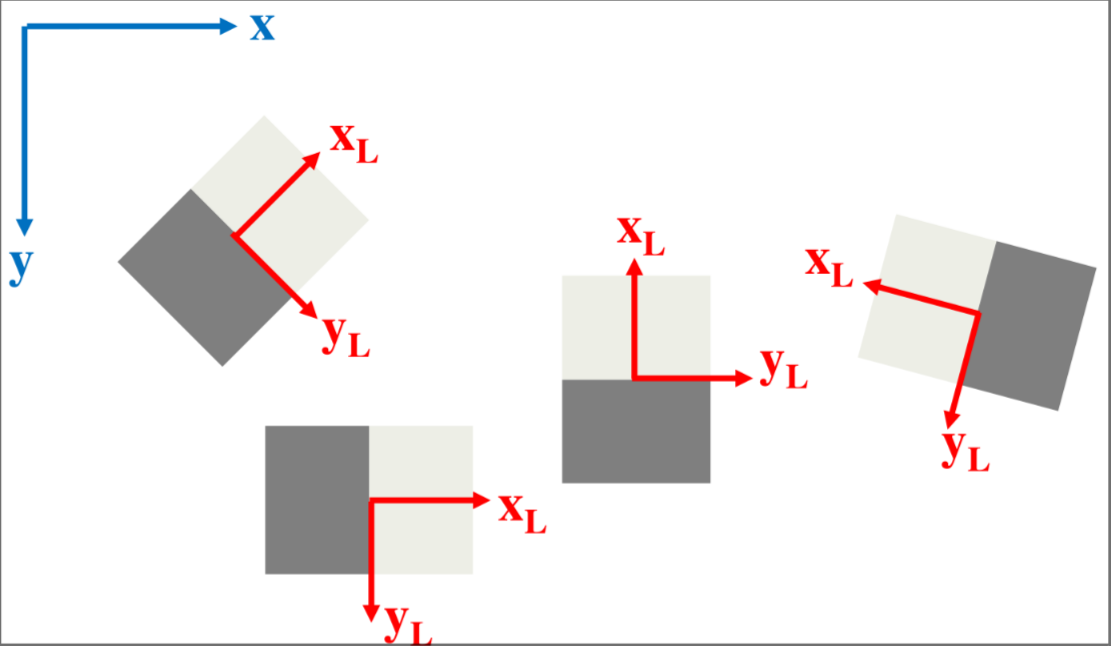
DOG CANONICAL ORIENTATION
Given a keypoint the orientation $\theta$ and magnitude $m$ is given by
$$ m(x,y) = \sqrt{(L(x+1,y)- L(x-1,y))^2 + (L(x,y+1)- L(x,y-1))^2} $$ $$ \theta(x,y) = \tan^{-1}{\frac{L(x,y+1)- L(x,y-1))}{L(x+1,y)- L(x-1,y))}} $$
Then an orientation histogram is computed with a bin size of $10^{\degree}$ with the contributions of each pixel of the belonging to a neighborhood of the keypoint.
The contribution of a single point is obtained by the gradient magnitude weighted by a Gaussian with $\sigma =1.5\sigma_S$ to account for the scale of the keypoint
then the highest peak of the histogram is considered for the canonical orientation with the 2 neighbors