data warehouse architectures
requirements
separation
- analitycal and transactional processing should be take apart
scalability
- the DWH need to be capable of handle large amounts of data
extensibility
- the DWH should be able to host new applications without the need to redesign the hole system
security
- the access to the DWH should be monitored
administrability
- the DWH should be easy to manage
single layer architecture
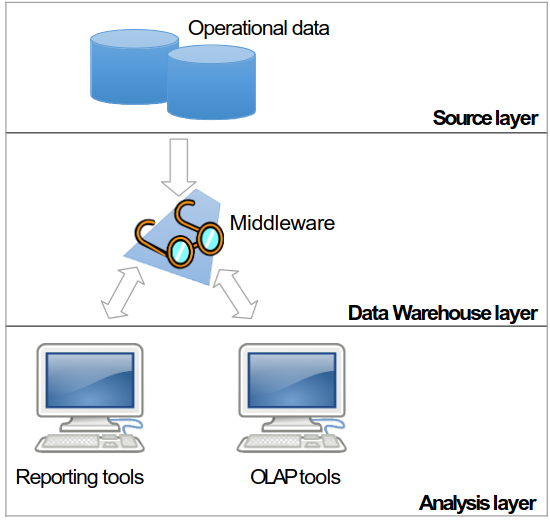
- the goal is to minimize the data collected in the DWH by reducing the separation between source layer and analysis layer
- to achieve this, a middleware software need to abstract the complexity and the divergency of the Source layer data
| PROS | CONS |
|---|---|
| the space occupation is minimized | no separation between source and analysis layers |
two layers architecture
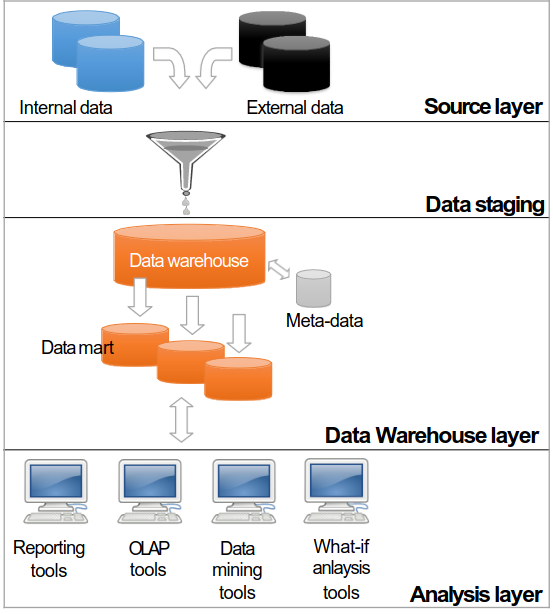
- in this architecture data are extracted from source layers trough ETL and are inserted in a data warehouse layer where they are stored and accessed by the analysis layer
- the source and the analysis layer are separated but there is more space occupied
| PROS | CONS |
|---|---|
| source and analysis data are separated | less space optimization |
three layers architecture
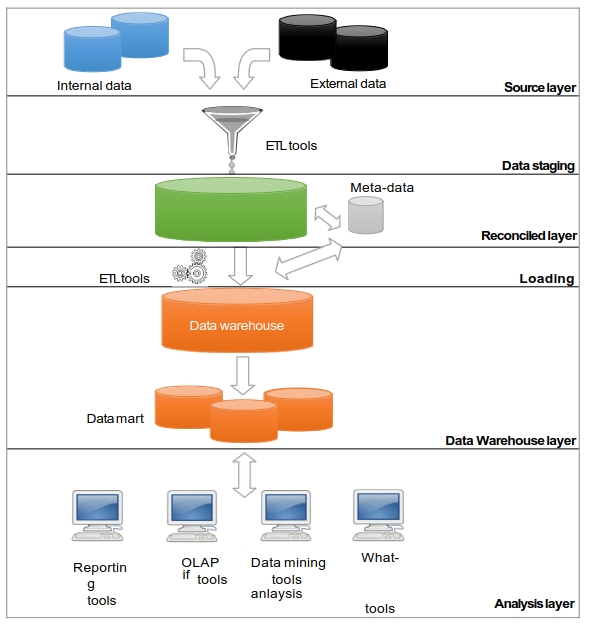
- the reconciled layer is added to the two layers architecture that creates a consistent model of the data and separate data extraction problem and integration problem
| PROS | CONS |
|---|---|
| more logical separation between the problem’s management | more data redundancy |